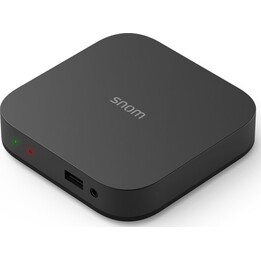
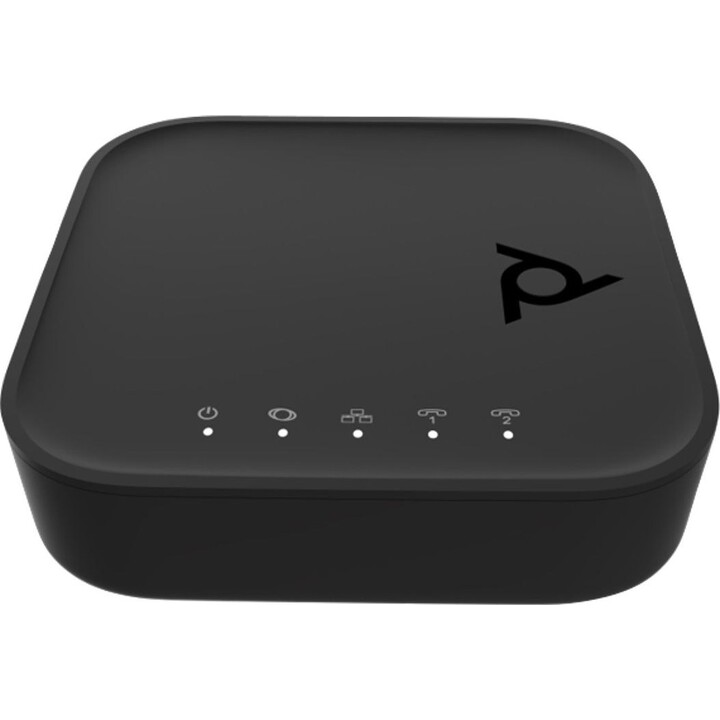

The HP Poly ATA 402 is a VoIP adapter designed for offices and small installations that wish to switch to IP calling while continuing to use their current analogue handsets. It links existing analogue phones to a voice-over-IP network, and its compact black housing, two FXS ports and Open SIP support make it a practical route onto the network.
Highlights
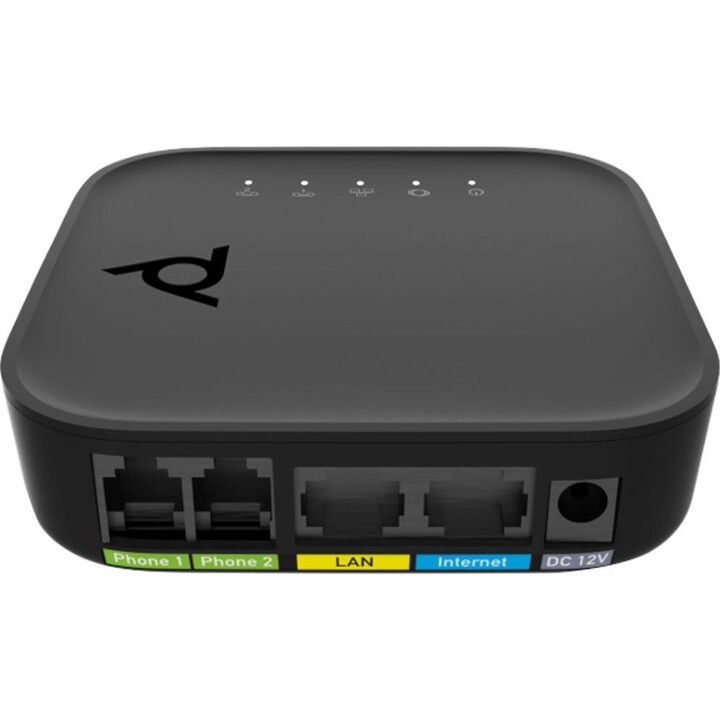
- Thanks to its two FXS ports (RJ-11), two analogue phones or lines can be connected to the VoIP service, so current handsets remain in use.
- Integration with your VoIP platform is straightforward thanks to Open SIP (SIPv2) support.
- The G.711alaw and OPUS voice codecs allow you to balance call quality against bandwidth.
- The adapter connects to the network through one Ethernet LAN port (RJ-45).
- The device includes one USB 2.0 port.
- Management and configuration traffic can be protected with HTTPS support.
- Measuring 96 mm wide, 96 mm deep and 22 mm high and weighing 85 g, this compact black unit occupies very little space.
Technical specifications
Features
- Voice codecs: G.711alaw, OPUS
- Product colour: Black
- Certification: FCC part 15 (CFR 47) class B, CE
Protocols
Security
- Security algorithms: HTTPS
Ports & interfaces
- Ethernet LAN (RJ-45) ports: 1
- Modem (RJ-11) ports: 2
- USB 2.0 ports quantity: 1
Power
- Power source type: DC
- AC input voltage: 100-240 V
- AC input frequency: 50/60 Hz
- Output voltage: 5 V
- Output current: 1 A
Technical details
- Pallet gross weight: 357 kg
- Compliance certificates: Federal Communications Commission (FCC)
Operational conditions
- Operating temperature (T-T): 0 - 40 °C
- Storage temperature (T-T): -40 - 70 °C
- Operating relative humidity (H-H): 5 - 95%
Weight & dimensions
- Width: 96 mm
- Depth: 96 mm
- Height: 22 mm
- Weight: 85 g
- Package weight: 300 g
- Package depth: 210 mm
- Package width: 190 mm
- Package height: 55 mm
Manufacturer technical data.
Frequently asked questions
Can I keep my existing analogue phones?
Yes. Two FXS ports (RJ-11) are provided, so your analogue phones can be connected and used over the VoIP network rather than being replaced.
Which VoIP protocol does it use?
It supports Open SIP, specifically SIPv2, along with the G.711alaw and OPUS voice codecs.
How is it powered?
An external power supply feeds it with direct current: 100-240 V AC input at 50/60 Hz, with 5 V output at 1 A.
What are its operating conditions?
It is intended for operation between 0 and 40 °C and at a relative humidity of 5 to 95%.